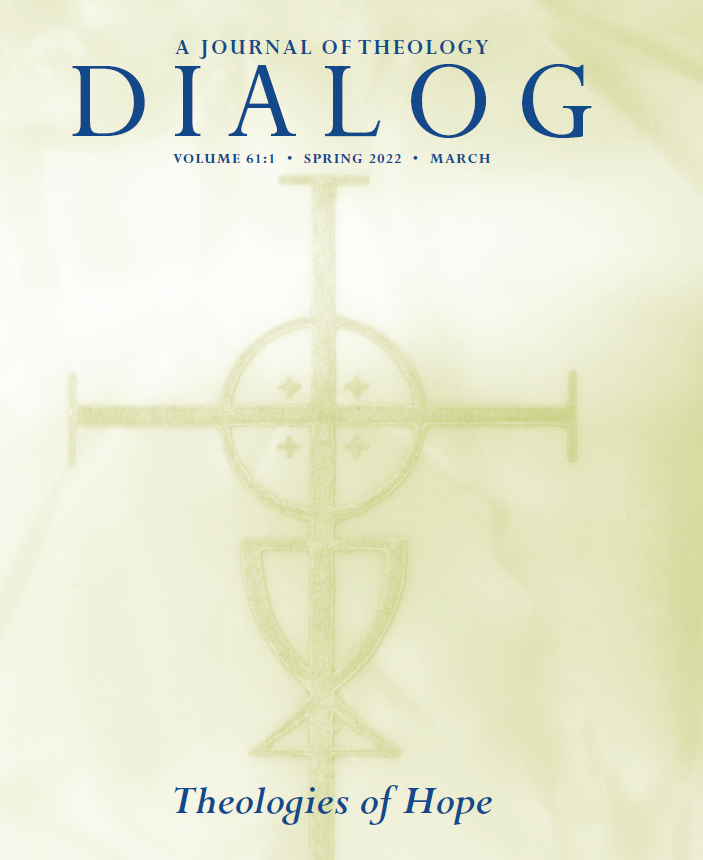
Why reconsider hope?
Risto Saarinen and Gao Yuan introduce the “Theologies of Hope” issue of Dialog by asking how hope should be reconsidered in changing cultural, scientific and religious contexts.
The editorial identifies three reasons for renewed reflection: global crises such as climate change and the COVID-19 pandemic; expanding interdisciplinary debates, especially in psychology; and encounters between Christianity and other religious traditions.
After Moltmann: continuity and new tasks
The authors acknowledge Jürgen Moltmann’s formative contribution to the theology of hope since the 1960s. Their purpose is not to dismiss this legacy, but to consider the tasks facing a new generation in the circumstances of the twenty-first century.
The editorial connects hope with contemporary discussions of reconciliation, memory and death, as well as the dangers of populism and neo-tribalism. It thereby places theological reflection within a wider field of social and intellectual challenges.
Desire, possibility and temporal horizons
The editorial discusses a common philosophical account of hope involving both a desire for an outcome and a belief that the outcome is possible. It also notes the plurality of experiences and understandings that this account seeks to describe.
Hope in the present
Hope is not restricted to events that have yet to happen. Concern about whether it is already too late to respond to environmental damage also involves a desire directed towards present reality.
Hope directed towards the past
Restorative and nostalgic hopes seek the renewal of an earlier condition. The authors draw attention to the ambiguity of such aspirations, particularly when they enter political rhetoric.
This temporal breadth helps explain why hope cannot be understood solely as confidence in a future event.
Hope beyond a single tradition
The authors question the assumption that hope is prominent in Christianity but irrelevant to other religions. Traditions concerned with human perfection and an ultimate relation to heaven or the divine can also articulate distinctive forms of expectation.
Chinese traditions, including Confucianism, enter this discussion through their reflections on ideal humanity and ideal society. The editorial identifies this as an important field for dialogue concerning a shared global future.
Connecting theology with lived crises
Writing as co-editors of the issue, Saarinen and Gao explain their aim of bringing traditional theological resources into conversation with different cultural and scientific contexts.
The editorial highlights the practical orientation of the collection. It discusses Antje Jackelén’s response to the pandemic in Northern Europe and points towards the continuing significance of environmental questions and dialogue with Chinese culture and religion.
The issue also includes Gao Yuan’s separate article on deification and sanctification in Finnish Lutheran and Chinese Neo-Confucian dialogue. That contribution is a distinct publication and should be cited separately.
Explore the related study ↗An interdisciplinary and intercultural agenda
Situating hope in contemporary challenges
The editorial connects theological inquiry with ecological crises, the pandemic and changing social conditions.
Opening dialogue with other disciplines
It brings philosophical and psychological approaches into view without reducing theological hope to a single general definition.
Including Chinese intellectual resources
The text identifies Chinese reflections on ideal humanity and society as relevant to discussions of hope and the global future.
Framing a collaborative scholarly conversation
Its role is to introduce and connect the thematic issue’s contributions. As a jointly authored editorial, its contribution lies in the agenda and framing it develops.
Cite the original editorial
Cite this overview
When citing the original editorial, retain both authors in their published order. When using this overview, acknowledge the author and this page.
Copyright & citation policy ↗