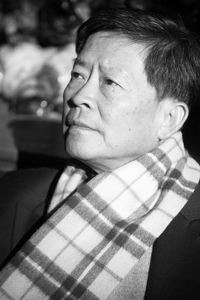
A reporter’s portrait
The reporter describes meeting Gao Xuanyang during a demanding sequence of public lectures in Beijing. Alongside his willingness to keep speaking and teaching, the account records the emotional difficulty of returning to childhood memories. The contrast gives the profile its personal scale: a public intellectual appears as someone whose life of thought remains marked by earlier experiences.
The question of home runs through this opening. The reporter presents Gao Xuanyang as a person whose cultural identity did not fit neatly into the places in which he lived. His attachment to a wooded landscape near his French residence provides one setting for this unresolved sense of belonging.
Childhood in Indonesia
In the oral account, Gao Xuanyang describes growing up in a Chinese teaching family in Indonesia. His parents’ work was embedded in the local Chinese community, but conflict and insecurity disrupted that environment. He recalls displacement, confinement and severe material hardship during childhood.
These recollections connect large political events with the daily work of survival. Carrying water, collecting firewood and helping his family became responsibilities assumed at a young age. The English guide retains these as elements of Gao Xuanyang’s remembered experience, rather than treating the interview as an independently verified history of Indonesia.
The decision to return to China
His mother’s illness intensified the family’s vulnerability during their displacement. Gao Xuanyang’s account also remembers assistance from local Indonesian people, including a coffee-shop owner who gave the family shelter while his mother recovered. The narrative preserves acts of generosity alongside the suffering it describes.
The experience helped shape his determination to seek a future in China. In this part of the account, the desire to return is associated with the hope of security and belonging. It becomes a recurring motive in a life that would later cross several more borders.
From Northeast China to Peking University
Gao Xuanyang recalls returning to China in 1952, at the age of thirteen, and choosing to study in the northeast. The change brought a different climate, diet and daily routine. His account emphasises the conviction with which he accepted these adjustments.
School reading helped direct his interest towards philosophy, and he subsequently entered Peking University. Looking back on the period from 1957 to 1966, he describes academic study alternating with labour. The ambition he associates with this education was to acquire knowledge that could be put to the service of society.
Writing towards a new departure
The narrative dates his move to Hong Kong with his family to 5 March 1978. There he found opportunities to publish and a means of supporting the next stage of his studies. Materials accumulated during earlier years became the basis of an intensive period of writing.
According to his recollection, he produced eight books and approximately two million Chinese characters of text in about eighteen months. The subjects included contemporary Western intellectual movements and philosophical biography. Writing supplied both an intellectual outlet and the financial resources for pursuing doctoral study in Europe.
Paris and philosophical encounters
In the Paris section, Gao Xuanyang recalls his doctoral supervisor Henri Birault and his decision to work on Nietzsche. The account presents a scholar arriving with substantial reading and publishing experience, while entering a new setting for philosophical research.
He also describes meeting Jacques Derrida and becoming involved in seminar work at the Collège international de philosophie following its founding in 1983. Their exchanges about Chinese thought are reported here as Gao’s recollections. They form part of a broader account of intellectual movement between Chinese and European traditions, rather than evidence for a single fixed position held by Derrida.